

Why Am I Doing Everything Right and Still Feel Like I'm Struggling?
Because wellbeing is more interconnected than we've been taught.
If you've ever found yourself wondering, "Why do I still feel overwhelmed when I'm doing everything I'm supposed to be doing?" you're not alone.
Perhaps you've started exercising regularly. You've tried eating healthier. You've downloaded the meditation app, listened to the podcasts, read the books, and made a genuine effort to prioritize self-care. Yet despite your best intentions, something still feels out of balance.
It's easy to conclude that the problem must be you.
Our culture often reinforces that belief. We are told to work harder, think more positively, become more resilient, manage stress better, and simply try harder. When those strategies don't produce the lasting change we hoped for, many of us quietly begin to wonder whether we are somehow failing.
But what if the problem isn't a lack of motivation?
What if you've simply been given an incomplete map?
Looking Through Only One Window
Imagine standing outside a beautiful old house with ten windows.
You look through one window and see a tidy kitchen. From another, you notice shelves overflowing with books. A third reveals children laughing together. Through another, you see someone sitting alone in silence.
If you looked through only one window, you might believe you understood the entire house. But each window offers only one perspective. The house itself is far more complex than any single view.
People are much the same.
We often try to understand wellbeing by looking through only one window. We focus on physical health, mental health, work, relationships, finances, or stress as though each exists independently. In reality, every dimension of our lives influences the others. We cannot fully understand a person by examining only one aspect of their experience.
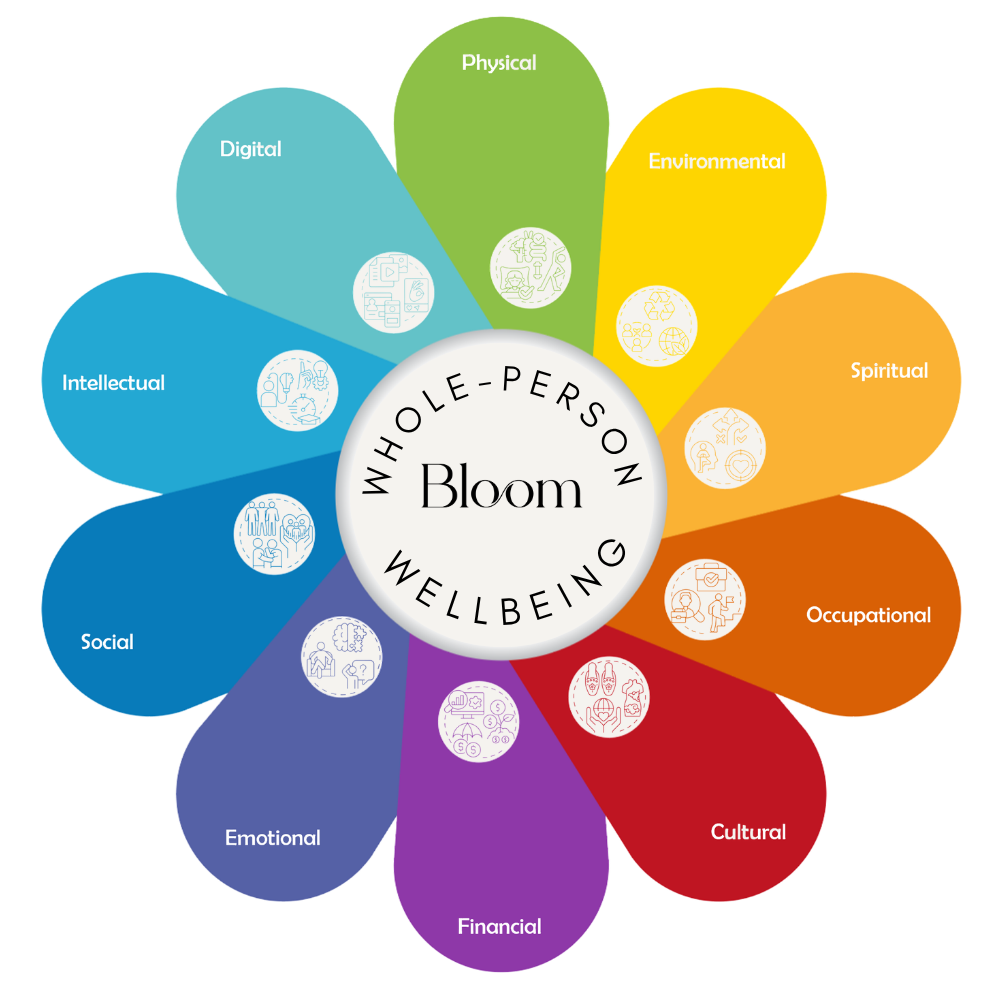
This is one of the reasons I developed Bloom's Ten Dimensions of Wellbeing.
Rather than viewing wellbeing as a collection of separate categories, I see it as an interconnected system. Every dimension offers another window through which we can better understand the same whole person.
The Ten Dimensions of Wellbeing
Physical Wellbeing
Physical wellbeing extends far beyond exercise or the number on a scale. It includes sleep, nutrition, movement, illness, pain, rest, energy, and the everyday choices that influence how our bodies function. Our bodies often communicate what our minds have not yet acknowledged.
Reflection: If my body could speak honestly today, what would it ask of me?
Emotional Wellbeing
Emotional wellbeing is not about being happy all the time. It is about recognizing, understanding, expressing, and responding to emotions in ways that help us navigate life with greater awareness and flexibility. Every emotion carries information. Emotional wellbeing grows when we learn to listen without allowing our emotions to completely define or control us.
Reflection: What emotion have I been trying hardest not to feel, and what might it be trying to tell me?
Intellectual Wellbeing
Intellectual wellbeing reflects our willingness to remain curious, continue learning, think critically, express creativity, challenge assumptions, and stay open to new ideas. It is nurtured whenever we explore, create, ask questions, or discover something new about ourselves or the world around us. Growth rarely comes from having all the answers. It comes from remaining willing to ask better questions.
Reflection: What have I been curious enough to explore, create, or learn recently?
Environmental Wellbeing
Our surroundings shape us more than we often recognize. The homes we live in, the workplaces we occupy, the schools we attend, the neighborhoods we inhabit, and even the emotional climate created by the people around us all influence our capacity to thrive. Sometimes the healthiest response to chronic distress is not changing ourselves but changing the environment in which we are trying to grow.
Reflection: Which environments consistently leave me feeling nourished, and which leave me feeling depleted?
Spiritual Wellbeing
Spiritual wellbeing involves connection with meaning, purpose, values, or something greater than ourselves. For some people this is expressed through religion or faith. For others it is experienced through nature, creativity, relationships, service, or a commitment to deeply held values. Spiritual wellbeing asks what gives our lives meaning beyond simply getting through another day.
Reflection: What helps me remain grounded when life feels uncertain?
Occupational Wellbeing
Occupational wellbeing is about more than employment. Whether we are working, studying, caregiving, volunteering, or retired, we all seek purpose and meaning in how we spend our time. Sustainable wellbeing asks not only what we do, but whether the way we spend our days aligns with what matters most to us.
Reflection: Does the way I spend most of my time reflect the life I hope to build?
Cultural Wellbeing
Our identities, traditions, histories, languages, communities, and lived experiences shape how we understand ourselves and how we move through the world. Cultural wellbeing recognizes that belonging matters. Feeling seen, valued, and able to honor important parts of our identity contributes significantly to our overall wellbeing.
Reflection: What parts of my identity help me feel most at home in the world?
Financial Wellbeing
Financial wellbeing is not determined by wealth alone. It involves feeling informed, capable, and reasonably secure in meeting our needs and making decisions about money. Financial stress has a remarkable ability to influence nearly every other dimension of wellbeing, even when we try to ignore it.
Reflection: How much mental and emotional energy is financial stress quietly consuming in my life?
Social Wellbeing
Human beings are wired for connection. Social wellbeing is built through relationships that foster belonging, trust, mutual support, and authenticity. The goal is not to know more people. It is to cultivate relationships where we can safely be ourselves.
Reflection: Where, and with whom, do I feel most accepted as I am?

Digital Wellbeing
Technology has become woven into nearly every aspect of modern life. Digital wellbeing is not about rejecting technology but using it intentionally. Our devices can strengthen relationships, increase access to information, and improve our lives. They can also contribute to distraction, comparison, burnout, poor sleep, and constant mental stimulation. Digital wellbeing invites us to ask whether our technology is serving us or whether we have quietly begun serving it.
Reflection: How do I usually feel after spending time online, and what does that tell me?
None of These Dimensions Exists in Isolation
It is tempting to think about these dimensions as ten separate boxes to check. In reality, they behave much more like the roots of a tree.
Imagine someone who finally begins sleeping better. Improved sleep increases energy. Greater energy makes it easier to prepare nourishing meals or take a walk. Physical movement helps regulate stress. Lower stress improves emotional wellbeing. Feeling emotionally stronger makes reconnecting with friends feel more manageable. Those relationships provide encouragement to pursue a new opportunity at work. Greater financial stability reduces chronic anxiety at home.
One small change begins to influence many others. The opposite is equally true.
A toxic workplace may gradually erode emotional wellbeing. Chronic stress interferes with sleep. Poor sleep reduces concentration. Reduced concentration affects performance and confidence. Financial worries increase. Relationships become strained. Physical symptoms begin to appear. Eventually someone looks in the mirror and concludes, "Something must be wrong with me."
Perhaps nothing is wrong with them. Perhaps they are responding exactly as human beings often do when one part of an interconnected system has been under strain for too long.
People aren't collections of separate problems to solve. They're interconnected human beings living within interconnected systems. Families, workplaces, schools, communities, healthcare systems, culture, policies, relationships, and life experiences all shape our wellbeing in ways that are often invisible until we step back and look at the whole picture.
This is why whole-person wellbeing matters.
A Different Way to Think About Wellbeing
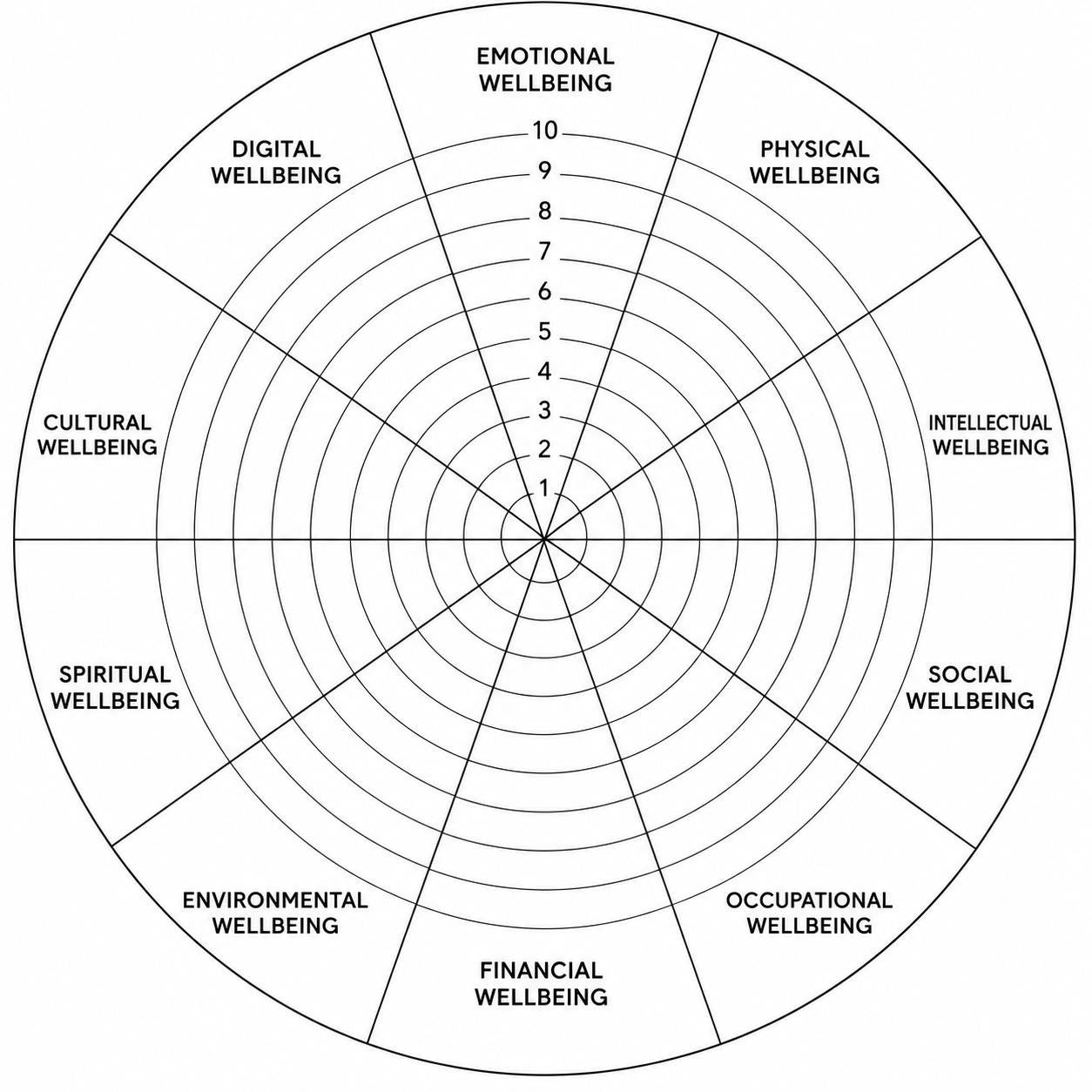
The goal of Bloom's framework is not to help you become better at managing ten separate parts of your life. It is to help you better understand the one life those ten dimensions are already shaping together.
Like a garden, not every area requires equal attention at every moment. Different seasons call for different forms of care. There will be times when emotional healing becomes the priority. Other seasons may call for strengthening relationships, rebuilding financial stability, reconnecting with purpose, or changing an environment that no longer allows you to flourish.
The goal is not perfect balance. The goal is greater awareness.
When we stop judging ourselves for struggling and begin asking more curious questions, we often discover that the answers are more compassionate and far more useful.
Reflection
As you reflect on your own wellbeing, consider the following questions:
Which dimension of wellbeing currently feels strongest in your life, and what has contributed to that strength?
Which dimension has been quietly asking for your attention?
How might one area of your life be influencing another in ways you had not previously recognized?
Have you ever blamed yourself for a struggle that may have been shaped, at least in part, by your environment or circumstances?
Which relationships, environments, or daily habits consistently leave you feeling nourished? Which leave you feeling depleted?
If you could make one small change that might create positive ripple effects throughout the rest of your life, what would it be?
What would change if you approached your wellbeing with greater curiosity instead of greater criticism?
At Bloom, I believe healing begins when we move beyond the single story. The same is true of wellbeing. We are not defined by a single diagnosis, a single role, a single struggle, or a single dimension of our lives. We are whole people whose wellbeing is shaped by the many ways our experiences, relationships, environments, identities, and opportunities interact over time.
Understanding the whole picture does not solve every problem overnight. It does, however, offer something equally important: a more compassionate, more accurate, and more hopeful place from which to begin.
